Emitech: Italian leader in microwave technology for food safety
In the last decade, the enterprise has been involved in several scientific projects with National Re…In the last decade, the enterprise has been involved in several scientific projects with National Research Institutes to develop new technologies for physical disinfestations of organic and inorganic matrix. The technological innovation consists of a reverberation chamber equipped with microwave emitters.
In 2007, Emitech patented a microwave system (MiSyA AH-36-T) that can be used as sanitizer postharvest treatment on legumes seeds and corns.
MiSyA system uses the thermal power of microwaves for heating the produce: a mild heat treatment allows to reach a lethal temperature from 57 to 60°C in the biological agent (moulds, fungi, insects, etc.)
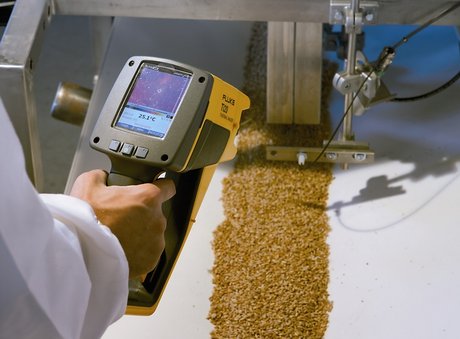
Survey of temperature at the exit of the MiSyA AH-36-T system.
The system has resulted to be effective against the biological agents at any growth stage. By comparing the MiSya system with the current chemical pesticides or sanitizers used for produce, the microwave technology does not alter the chemical and physical properties of produce, and especially it does not release residues either on produce or in the environment. In addition, there are no health risks during microwave treatment. MiSya plant is an environmentally friendly system, thus it can be used for organic food chains.
MiSya plants can work using different power according to the hourly amount of produce that must be treated, furthermore the conveyer system varies according to the produce being treated.
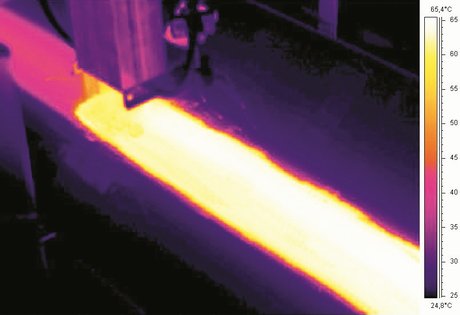
Thermal photography of the produce at the exit of the MiSyA AH-36-T system.
The Manager of Emitech, Dr. Diaferia Nicola, has said that since 2005 the enterprise studies the efficacy of microwave technology not only for postharvest food safety but also for pre-harvest food safety.
Emitech patented 5 years ago a microwave system to destroy both weeds and insects developing in cultivated soils, in historic monuments and artistic buildings. The enterprise, in cooperation with research institutes and Universities developed technological systems similar to that described by Professor Graham Brodie of Melbourne University in a previous article published by FreshPlaza.
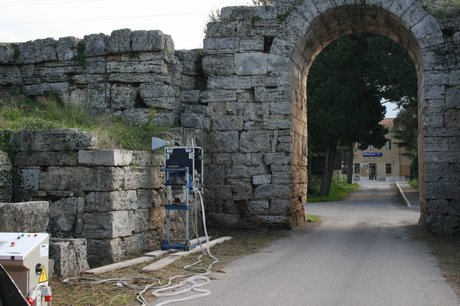
In the photo the Emitech system is destroying the weeds developed in the historic Paestum wall.
The system for weeds control consists in a reverberation chamber opened and equipped with a stirring system.
The weed control system can be manually, electrically or pneumatically lifted, it is mounted on four wheels that allow it to be moved on a horizontal plane. By comparing the Emitech system with the chemical products supplied by atomizer, the microwave system is more environmentally friendly and more effective thanks to the uniform distribution on soil.
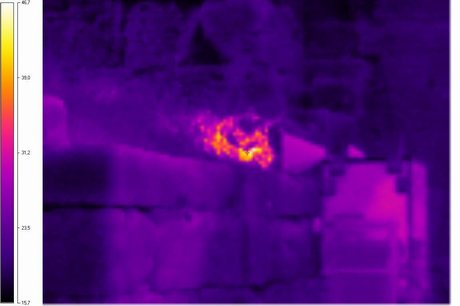
Thermal photography during microwave treatment against weeds developed in the historic Paestum wall. The detail in the photo shows the heating of the weeds.
For weed control, the Emitech has:
► mobile radiation system at single 6 Kwatt generator with Horn applicator
► mobile system with a 24 kwatt generator that can be used both in open field and in greenhouse.
The patent for the system to control weeds was asked in 2007 by Emitech, and it was issued in may 2011; now Emitech would like to export its patented technology in Australia, thus the Emitech is disposed to cooperate with Prof. G. Brodie, if he so wishes.