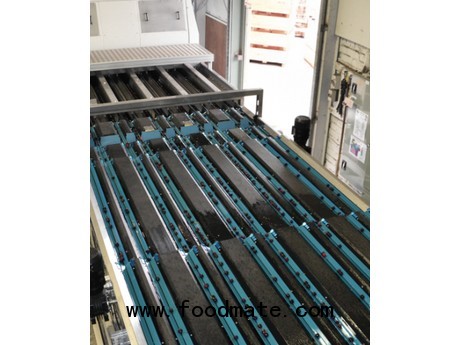
NDRI Southern Regional Station uses innovative methods to produce TDPs
National Dairy Research Institute (Southern Regional Station), Bengaluru, has embarked upon utilisin…National Dairy Research Institute (Southern Regional Station), Bengaluru, has embarked upon utilising innovative technologies for the development of traditional milk products (TDPs). With the emergence of a promising global market for ethnic Indian dairy products, the institute has seen enormous business opportunities.
“The global market for TDP is estimated at Rs 30 million, so opportunities to take advantage of this niche market exist,” K Jayaraj Rao, senior scientist, and C N Pagote, principal scientist, National Dairy Research Institute (Southern Regional Station), said.
“The major traditional sweets are varieties of burfi, sandesh, peda, basundi, gulab jamun, kheer, rasogolla and payasam. Over the years their method of manufacture has remained unchanged, but innovations have been made.
This is where the institute has developed several innovations, including mechanisation of manufacturing processes, dietetic or low calorie products or health foods, upgradation of existing products, membrane processing, retort processing, osmotic dehydration, individual quick freezing (IQF), sugar crystallisation, packaging and innovative products or concepts,” they added.
In a paper presented at the XXIInd Indian Convention of Food Scientists and Technologists organised on the Central Food Technological Research Institute (CFTRI) campus in Mysore earlier this month, Rao and Pagote said that India produces 13 million tonnes of milk annually. This is the largest and accounts for about 16 per cent of the world's total output.
“Milk and milk products are the second largest agricultural product in India. Its production comes next only to rice, exceeding even the wheat,” the two scientists said.
Milk constitutes 67 per cent of the livestock gross domestic product (GDP), 22 pe cent of agricultural GDP and about 5.5 per cent of the national GDP. The household and non-organised sector handle about 82 per cent, and about 18 per cent is handled by the organised sector.
Of the total milk production, about 50 per cent is being converted into indigenous dairy products. The market of Indian milk products is estimated to be more than Rs 65,000 crores.
A few organised players started production of traditional milk products (TDPs) on a commercial scale. The TDP market is the largest in value after liquid milk, and is estimated at $3 billion in India and $1 billion overseas.
Some 900,000 tonnes of khoa valued at Rs 45,000 million is produced in India, along with around 1,20,000 tonnes of chhana, a coagulated milk product, valued at Rs 6,000 million. Almost all the milk sweets in India are made from khoa and chhana.
Although India’s traditional dairy products industry is grossly undermanaged, it provides employment opportunities. The new processes help manufacturers to promote new products or modify existing versions.
The unorganised sector which produces the traditional milk sweets adopt innovations at their own level of operation and convenience. Hence innovations to a large extent remained at a small scale.
“Modern technologies like ohmic heating, high-pressure processing, pulse electric heating and nano-technology though promising are yet to be explored in thr traditional dairy products field,” they added.